How to clean white Converse and make them white again
A white Converse ages in two stages. First, the canvas turns gray, which is easily fixed. Then the rubber yellows, and that's when most people give up or make it worse with bleach. The two problems are not treated in the same way, and that's the difference between salvaged white sneakers and a pair that needs replacing.
To clean a white Converse, hand wash the canvas in a solution of lukewarm water and mild soap, treat the rubber separately with baking soda or a magic eraser, rinse until the water runs clear, then let air dry in the shade. Never soak the pair or use bleach: it's the drying process that causes yellowing, not dirt.
Key takeaways in 30 seconds
· Canvas and rubber: two materials, two methods, never the same product.
· Rinse until the water runs clear. Soap residue is the primary cause of yellow stains.
· Air dry in the shade for at least 12 hours. Direct sunlight yellows the rubber.
· Wash laces and insoles separately, otherwise they will re-contaminate your clean sneakers.
· Light maintenance twice a month avoids all harsh treatments.
Why your white Converse turn yellow
The canvas turns gray because it picks up dust, rain, and friction. This is surface dirt and can be easily cleaned, regardless of the model. The rubber, however, yellows for another reason: the material oxidizes, and heat accelerates the process. A pair dried in the sun or near a radiator will therefore often appear yellower than before washing. The second culprit is poorly rinsed soap, which dries to form a yellowish film, usually visible as a halo on the canvas. In other words, most yellowed shoes are not dirty: they were improperly dried.
How to wash the canvas of your white sneakers
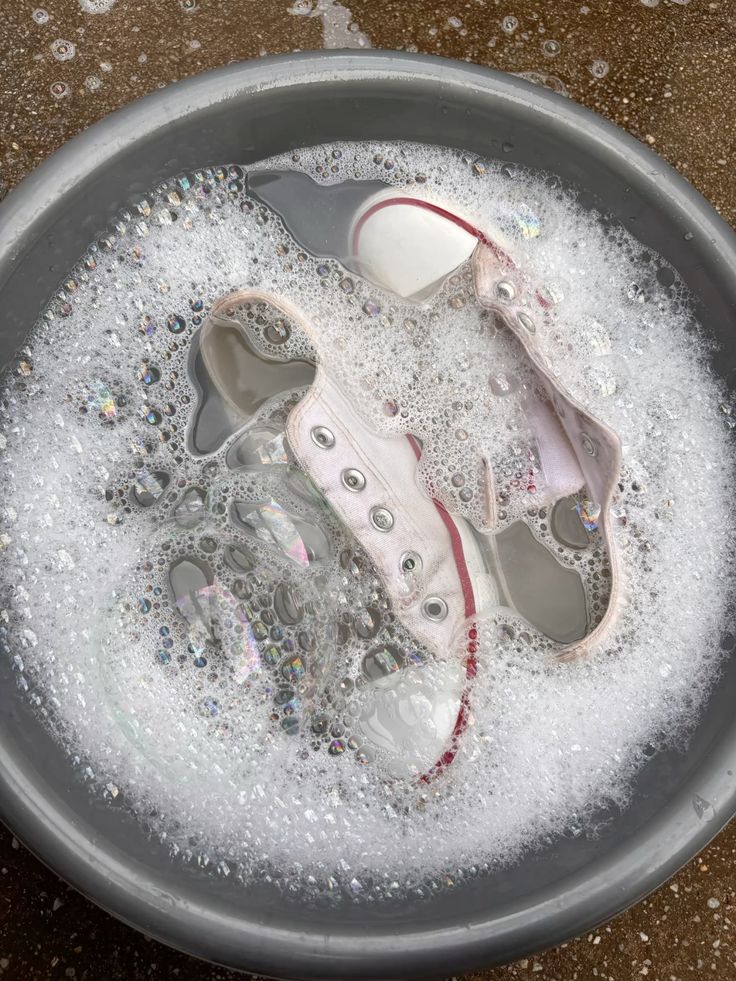
Before you start, remove the laces and insoles and wash them separately in a bowl of lukewarm soapy water, rubbing them between your fingers. Then dry brush the canvas to remove dust. For a muddy pair, let them dry before brushing: wet dirt gets embedded in the weave, dry dirt comes off. Use a soft-bristled brush, plus an old toothbrush for the seams, and a mild soap like Marseille soap or black soap.
Rub in small circles with lukewarm, never hot, water, working on the entire surface: cleaning only the stain is the surest way to create a halo around it. Then wipe with a damp cloth as many times as necessary until it comes out without foam—this is the step everyone rushes and the most important one. Blot with a dry cloth, stuff the shoe with absorbent paper to soak up moisture and maintain its shape, change it after 2 hours, then let it air dry at room temperature. Allow 12 hours for canvas, longer if the room is humid: it must be completely dry before re-lacing.
The rubber: toe cap and sole
This is the part that makes the visual difference, because the color of the rubber is compared by eye much faster than that of the canvas. Two solutions depending on the condition: a paste of baking soda and water applied with a toothbrush, left for 10 minutes then rinsed, effective on gray and scuff marks; or a slightly dampened magic eraser, which cleans the trim in a few passes and remains the most effective on persistent yellowing. It is abrasive, so reserve it for rubber.
Two products often come up and deserve a clear answer. Toothpaste works, but only on rubber and as a classic white paste, never as colored gel: on canvas it leaves a film that grays as it dries. Sodium percarbonate, often recommended as a natural whitener, actually works on white cotton, but it requires water at 50 or 60 degrees and several hours of soaking to activate. These two conditions are precisely what should be avoided on a Converse, whose sole is glued: we do not recommend it here, reserve it for laundry. For a very yellowed pair, plan for 2 applications several days apart rather than one intense one.
What works and what causes damage
|
Product |
On Canvas |
On Rubber |
Verdict |
|
Marseille soap, black soap |
Yes |
Yes |
The basic, risk-free option |
|
Baking soda |
Sparingly |
Yes |
Good compromise for graying |
|
Magic eraser |
No, too abrasive |
Yes |
Most effective on yellowing |
|
Bleach, dryer |
No |
No |
Damages fibers, loosens soles |
What about the washing machine?
Converse excludes machine washing in its care instructions for all models, recommending lukewarm water and mild soap instead. In practice, a canvas pair can survive at 30 degrees, on a delicate cycle, without spinning, and in a mesh bag. We have detailed the protocol and its limitations in our article Converse in the washing machine: possible or not. To clean a white Converse, hand washing is still more effective, because the drum doesn't tackle the rubber, which is precisely where the yellowing is most visible.
Keeping white sneakers clean longer
Waterproof new canvas before the first outing, treat stains on the same day, and alternate with another pair so the canvas dries completely between wears. Store your sneakers away from light, as rubber also yellows behind glass. When the canvas is worn at the creases and the rubber is deeply yellowed, no product works miracles: our white Converse and all of our Converse are online with updated sizes, each pair authenticated before shipping.
Your questions about white Converse
How to whiten yellowed white Converse?
To clean yellowed white Converse, separate the materials. The canvas should be washed with lukewarm water and mild soap, ensuring thorough rinsing. Yellowed rubber can be treated with a slightly damp magic eraser, or with a baking soda paste. Then, dry them in the shade, without exception.
Can bleach be used?
No. Bleach attacks the canvas fibers, and on rubber, it accentuates yellowing instead of correcting it. Baking soda and a magic eraser yield better results without damaging the pair.
Why do my Converse yellow after washing?
Poorly rinsed soap drying as a yellowish film, or drying in the sun which oxidizes the rubber. Rinse until the water runs clear and let them dry in the shade to get almost new sneakers back.
How to wash white Converse in the washing machine?
Converse advises against it. If you do proceed: remove laces, use a laundry bag, wash at 30 degrees Celsius, on a delicate cycle, without spinning, and absolutely no dryer. Never soak them beforehand.
Bestsellers