How to lace your sneakers for each model?
In the official photo on nike.com, a white Air Force 1 '07 comes laced criss-cross all the way to the top, with the engraved AF1 dubrae sitting on the bottom row. Yet in its own size guide, Nike advises against lacing this model too tight, to avoid creases on the sides. Knowing how to lace your sneakers is therefore as much about comfort as it is about style.
We have gathered the seven lacing methods that matter for sneakers, with a diagram for each, followed by a table by model and the lace length you need. The instructions come from Nike's guides and from Ian Fieggen's reference website on shoelaces, reviewed on 24 October 2026.
How to read the diagrams?
Each diagram shows six pairs of eyelets seen from above, with the toe at the bottom and the tongue in the centre. A solid black line is the visible part of the lace. A dashed grey line runs inside the shoe. Whatever the technique, start with two ends of equal length.
Criss-cross lacing for all sneakers
This is the most common lacing method, also known as diagonal lacing. Nike presents it as the basis for all other techniques. It tightens evenly over the top of the foot.
1. Thread the lace through the two bottom eyelets, from the outside in, keeping the same length on each side.
2. Work your way up, crossing the two ends at each row, always with the same end on top.
3. Adjust the tension at each row, then tie. A double knot holds better if the lace slips.
Straight bar lacing for a clean look

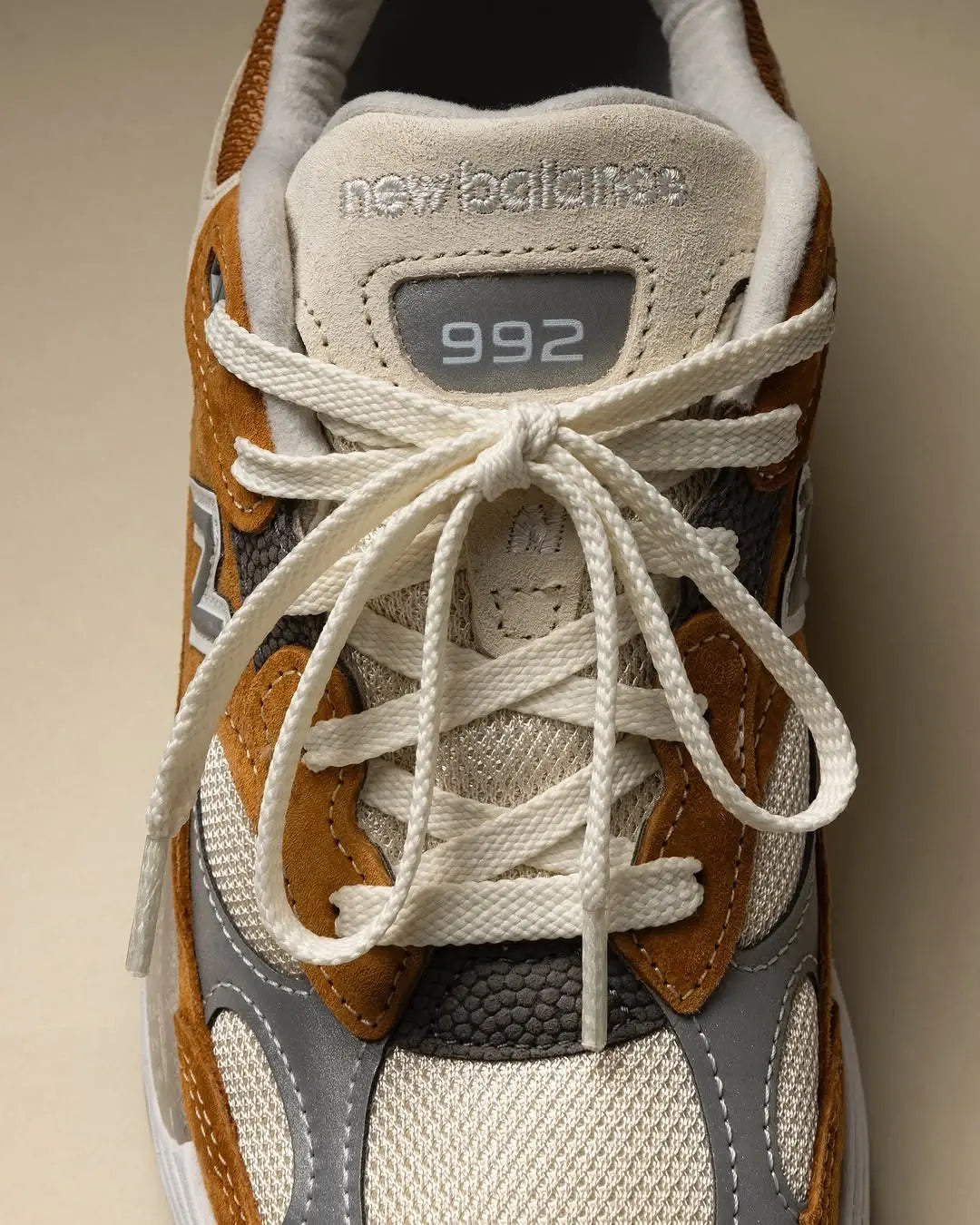
Straight lacing lines up horizontal bars with no visible crossing. The ends go up on the inside. Ian Fieggen ranks it among the comfortable lacing methods, with one limitation. It only works out evenly with an even number of eyelet pairs.
1. Run the lace as a bar across the bottom row, with both ends going into the shoe.
2. The left end goes up one hole on the inside, comes out and crosses over as a bar.
3. Then each end goes up two holes on the inside and crosses over as a bar. Repeat to the top.
Ladder lacing for high-top models

Borrowed from paratroopers' jump boots, ladder lacing creates vertical rails on the sides and rungs in the middle. It stays very tight once tied, which suits a Jordan 1 High well. On the downside, it requires a longer lace.
1. Run the lace on the inside across the bottom row and bring it out through both eyelets.
2. Take each end straight up on the outside to the next eyelet.
3. Cross over by sliding each end under the opposite vertical section, then go up one notch. Repeat to the top.
How to lace Air Force 1s loosely?

The Air Force 1, designed by Bruce Kilgore and released in 1982, is often worn loosely laced. The lacing stays criss-cross but not tight, the last pair of eyelets is left empty and the lace ends are tucked into the shoe. You can then slip them on without unlacing.
1. Unlace completely, then re-lace criss-cross without pulling on the ends.
2. Stop at the second-to-last pair of eyelets.
3. Tuck each end under the tongue, along the foot, without tying a knot.
This lacing also changes the size to choose. Nike's guide states that with looser lacing, you can go a full size down from your usual Nike size, compared with half a size for regular lacing. Our Air Force 1 size guide details the conversion.

For a bolder look, we also offer thewhite Air Force 1 Low with rope laces, a thick round lace tied in a big bow at the front. All versions are in our Nike Air Force 1 collection.

Hidden lacing with no visible knot

Hidden lacing builds on straight lacing, but the knot is tied under the tongue. Only clean bars remain on top. Fieggen notes it may cause slight discomfort and recommends placing the knot on the outer side of the foot.
1. Lace in bars as for straight lacing, up to the top row.
2. Both ends end up on the inside, between the last two rows.
3. Tie them on the inside with a simple or reef knot, then tuck the ends into the shoe.
Gap lacing for wide feet or a high instep

When the lace presses on the top of the foot, you skip a crossing where it hurts. Ian Fieggen calls this gap lacing. Nike suggests a variant for high arches, with straight runs from the middle to the top. For wide feet, the brand recommends skipping the first pair of eyelets at the bottom, which gives more room across the midfoot.
1. Lace criss-cross up to the row before the sensitive area.
2. Take each end straight up on the same side, without crossing.
3. Resume criss-cross lacing to the top and tie.
The last eyelet to lock the heel

The last eyelet, often left empty, is used to lock the heel in place. Nike describes two similar variants, heel lock lacing and loop lacing, for a heel that slips. According to the brand, this lock keeps the heel from moving and prevents blisters.
1. Lace criss-cross up to the second-to-last pair of eyelets.
2. Thread each end through the last eyelet on the same side, leaving a small loop on the outside.
3. Cross the ends, slide each one through the opposite loop, pull tight and tie.
Which lacing for which sneaker model?
How to lace your sneakers depends first and foremost on the model. Our recommendations cover the flagship models in our catalogue, to be adjusted to the width of your foot.
|
Model |
Recommended lacing |
Why |
|
Loose criss-cross or loose with no knot |
Nike advises against lacing too tight, as the leather creases on the sides |
|
|
Criss-cross, or straight for a clean look |
Low upper and original flat laces, which suit both |
|
|
Straight bar |
Slim, low profile, the bars follow the line of the upper |
|
|
New Balance 550 and 9060 |
Criss-cross, heel lock if the foot moves |
Models worn for walking, the heel needs to stay in place |
|
Criss-cross or ladder, last pair left empty |
High-top upper, leaving the last pair empty lets the ankle move |
|
|
adidas Campus 00s |
Criss-cross with wide flat laces |
The wide lace is part of the original look |
What lace length for how many eyelets?
Before switching to ladder or bar lacing, check the length. Count the eyelets on one side only, which gives you the number of pairs. The table combines Nike's recommendation with Fieggen's calculations for an average sneaker, with 50 mm between the left and right eyelets.
|
Eyelet pairs |
Nike |
Criss-cross lacing (Fieggen) |
Straight lacing (Fieggen) |
Ladder lacing (Fieggen) |
|
4 pairs |
69 cm |
91 cm |
80 cm |
90 cm |
|
5 pairs |
91 cm |
102 cm |
93 cm |
103 cm |
|
6 pairs |
114 cm |
112 cm |
96 cm |
116 cm |
|
7 pairs |
114 cm |
123 cm |
109 cm |
129 cm |
|
8 pairs |
137 cm |
133 cm |
112 cm |
142 cm |
Straight lacing needs less length, ladder lacing more. Without a table to hand, Fieggen gives a simple formula. Multiply the distance between two opposite eyelets by the total number of eyelets, then add 50 cm for the knot. A sneaker with 6 pairs and a 5 cm gap gives 110 cm. The most reliable option is still to measure the original lace.
All our laces are 120 cm long. Nike recommends 114 cm for 6 or 7 pairs of eyelets, Fieggen 112 cm for 6 pairs in criss-cross. The flat laces for adidas Campus match the original width, while the fluffy laces give a thicker volume. The full range is in our laces collection.

Flat laces or round laces?
Flat laces lie nicely flat in straight or hidden lacing, and they are the original lace on an Air Force 1, a Dunk or a Samba. Round laces, rope laces included, stand out more and are tied in a big bow, for a more eye-catching effect. A dirty white lace can be washed before being replaced; our article on how to wash white laces explains the method.

Which lacing should you choose in the end?
To know how to lace your sneakers without rereading everything, start with criss-cross and keep the other lacing methods for a specific need.
· For everyday wear, criss-cross lacing remains the most comfortable and the easiest to adjust.
· For a clean look on a Samba or a Dunk, switch to straight lacing.
· For an Air Force 1 you slip on without unlacing, choose loose lacing and one size down, as Nike advises.
· If your heel slips, use the last eyelet as a heel lock.
· With wide feet or a high instep, skip a crossing.
Frequently asked questions
How to lace your shoes without tying a knot?
Two options. Hidden lacing ties the ends on the inside, under the tongue, leaving only bars visible. Loose lacing simply tucks the ends into the shoe, on a pair you slip on without unlacing, like an Air Force 1.
What is the best way to lace your shoes?
For most sneakers, criss-cross lacing. It spreads the pressure and can be adjusted row by row. The other techniques fix a specific problem, such as a slipping heel or a squeezed foot, or serve style.
How to tie sneakers so the heel doesn't slip?
Use the last eyelet with a heel lock. The two side loops tighten the top of the upper around the ankle without putting more pressure on the forefoot.
Do you need to change laces when you change lacing style?
Not always. On a pair with 6 eyelets on each side, ladder lacing needs about 4 cm more lace than criss-cross, and straight lacing about 16 cm less, according to Fieggen's calculations. A 120 cm lace covers all three.
Sources
· Nike, « Bien lacer ses chaussures de running », nike.com/fr/a/techniques-lacage-chaussures-de-running, updated on 21 May 2024, accessed on 24 October 2026.
· Nike, Air Force 1 size guide, nike.com/fr/a/pointures-air-force-1, updated on 1 November 2024.
· Nike Help, « What Are the Best Laces for Nike Shoes? », nike.com/help/a/replace-shoelaces, accessed on 24 October 2026.
Ian Fieggen, Ian's Shoelace Site, pages Approximate Shoelace Lengths, Criss Cross, Straight Bar, Ladder, Hidden Knot, Gap and Lock Lacing, fieggen.com, updated on 13 August 2026.
Bestsellers