

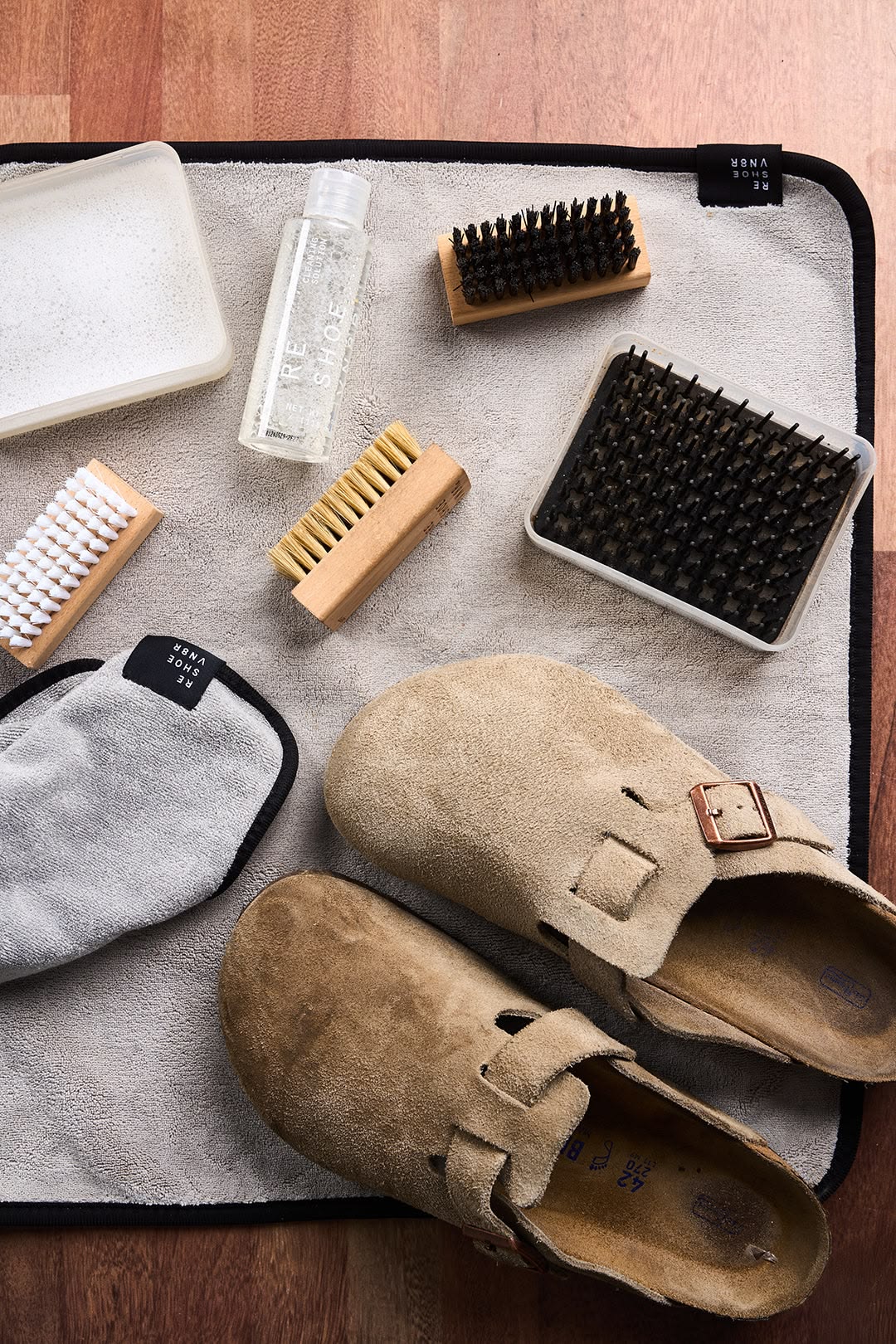
How to clean Birkenstocks without damaging them? The complete guide
Has the footbed of your Birkenstocks turned dark gray, and you no longer dare to wear them without socks? This is the fate of every pair worn for an entire summer. Good news: with the right steps, your sandals can get a new lease on life in just 20 minutes. Here is how to clean Birkenstocks step by step, with tips and tricks to avoid ruining the cork or suede.
Things to remember in 30 seconds
- Never put them in the washing machine, never soak them: the cork footbed would not survive it
- The winning duo for the footbed: soft brush + warm soapy water
- For odors, baking soda left overnight works miracles
- Dry at room temperature for 24 hours, away from the sun and radiators
- Only EVA models (100% synthetic) can withstand being fully rinsed with water
Can you get Birkenstocks wet?
Not really, and that is THE rule to remember before getting out the basin. The heart of a Birkenstock is its anatomical cork and latex footbed. It is a brilliant natural material for comfort, but it hates water: if soaked, the cork swells, cracks when drying, and loses its shape.
The brand is clear on this point: "Ensure that you do not put your shoes directly under running water or get them completely wet" (Birkenstock, official care guide). Forget about the washing machine, basin, or garden hose.
The only exception: 100% EVA models, like the Arizona EVA. These are made of pool-grade synthetic material, so you can rinse them under the tap without any risk.
Cleaning Birkenstocks by material: the summary table
Before you scrub, identify the material of your Birkenstock shoes. A suede Boston is not cleaned at all like a Birko-Flor Arizona. Here is the summary table:
| Material | How to identify it | Cleaning method |
| Birko-Flor | Smooth leather look, synthetic material | Damp cloth + mild soap, the easiest to maintain |
| Smooth leather | Natural grain, develops a patina over time | Slightly damp cloth, then nourishing grease or cream |
| Suede / nubuck | Velvet feel (Boston, Zurich) | Dry suede brush, special eraser for stains, never direct water |
| Birkibuc | Nubuck look, synthetic material | Soft dry brush, barely damp cloth if needed |
| EVA | Sandals made entirely of lightweight foam | Soap and water without restriction, the only one washable with plenty of water |
Suede is the most delicate of the bunch. If your Bostons got caught in the rain, let them dry completely before brushing, otherwise you will spread the stain. The complete method is the same as for suede sneakers, which we detail in our guide for cleaning suede sneakers.
Cleaning a dirty footbed, step by step
The footbed is the anatomical inner sole that provides all the sandal's comfort. It is also the part that gets dark the fastest: sweat, dust, friction from bare feet. The good news is that it cleans easily. Allow 15 minutes.
- Remove dust from the dry footbed with a soft brush or an old toothbrush
- Prepare a bowl of warm water with a few drops of mild soap (Marseille soap or leather shampoo)
- Scrub the footbed with small circular motions using the barely damp toothbrush, without soaking it
- Wipe off the foam with a clean, slightly damp cloth
- Let dry for 24 hours at room temperature
For a very dirty footbed, a baking soda paste works well: mix 2 tablespoons of baking soda with a little water, apply, leave on for 15 minutes, then remove with a damp cloth. The gray color will fade significantly, even if a pair worn for two summers will never be brand new again. Let’s be honest.
How to remove bad odors?
Cork absorbs sweat, which is also why they are so comfortable. The downside: odors build up.
The most effective method remains the simplest. Generously sprinkle the footbed with baking soda, leave it on overnight, then brush or vacuum it the next day. Baking soda neutralizes odors instead of masking them; it is one of the most effective methods and by far the cheapest. Repeat every 2 or 3 weeks in the summer and the problem will disappear.
Drying: the step everyone gets wrong
Improper drying ruins more Birkenstocks than dirt itself. Using a radiator or placing them in direct sunlight is a bad idea: heat dries out the cork and cracks the leather.
Let your sandals dry at room temperature in a ventilated area with the straps open. Birkenstock recommends 24 hours for complete drying. So, be patient. Once the pair is dry, give the footbed a quick brush and they are ready to go again.
Protecting your Birkenstocks to space out cleanings
Also think about the outsole: a damp brush from time to time is enough to remove dirt stuck in the treads. For the rest, two simple steps are enough. On suede and nubuck, a clear waterproofing spray applied regularly (protecting the footbed with paper) prevents stains before they happen. On natural leather, a little grease or nourishing cream keeps the material supple.
You will find brushes, sprays, and suitable cleaners in our collection of sneaker care products.
Want a brand-new pair after all?
If your sandals have reached the end of their life despite all these care tips, take a look at the different pairs in our Birkenstock collection: we carry Boston suede clogs and Arizona sandals in all colors, authenticated and shipped in 24-72 hours.
FAQ: cleaning Birkenstocks
Can you wash Birkenstocks in the machine?
No, never. The water and the spin cycle destroy the cork footbed and peel off the straps. Only 100% EVA models can go under water, and even then, only by hand.
How to clean the inside of your Birkenstocks?
Dry soft brush, then a barely damp toothbrush with soapy water, using circular motions. For odors, use baking soda left overnight. Never soak the cork.
Does baking soda damage Birkenstocks?
No, provided you use it dry or as a light paste and remove it well after application. It is actually the safest product for the footbed, much gentler than a standard detergent.
How long does it take for Birkenstocks to dry?
About 24 hours at room temperature. Never in the sun or on a radiator: the heat cracks the cork and the leather.
Bestsellers